
Grain markets are under pressure in the early morning trade, will the market be able to find it’s footing into Thursday’s report?
Oliver Sloup joined Scott the Cow Guy on Monday morning to share his thought on the price action leading up to Thursday’s USDA report.
Corn
Technicals (May)
Consolidation appears to be the name of the game as daily ranges look to narrow ahead of Thursday’s report. With a mostly sideways trade, many of the technical support and resistance levels remain intact from yesterday’s report.
Bias: Bullish/Neutral
Resistance: 447 1/2-450****
Pivot: 441 3/4-444 1/2
Support: 431 1/2-435*, 421-422

Fundamental Notes
- The range of intended corn acres comes in from 90.0-93.472 million acres, with the average estimate being near 91.8 million acres.
- Yesterday’s weekly export sales report came in at 1,227,955 metric tons, within the range of expectations and about 100k MT less than last week.
- Markets will be closed on Friday in observance of Good Friday.
Fund Positioning
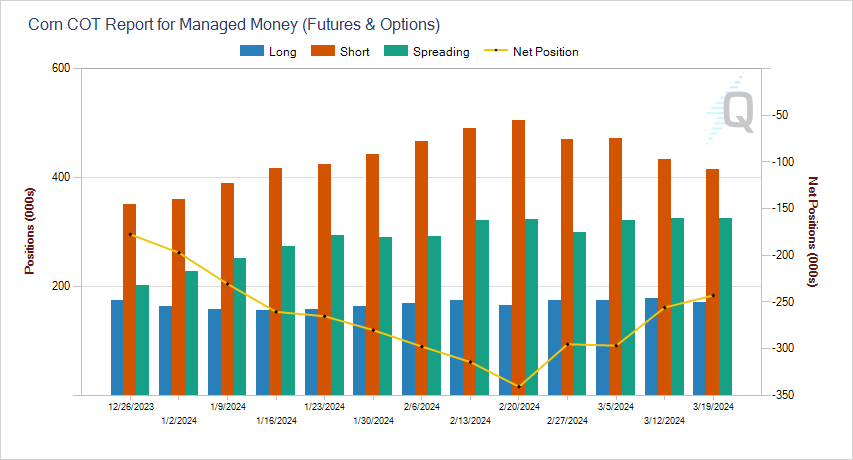
Friday’s Commitment of Traders report showed that Funds were net buyers of roughly 13k futures/options contracts, the bulk of that being short covering. That trims their net short position to 242,988 contracts. Broken down that is 171,123 longs VS 414,111 shorts..
Seasonal Trends
(Past performance is not necessarily indicative of future results)
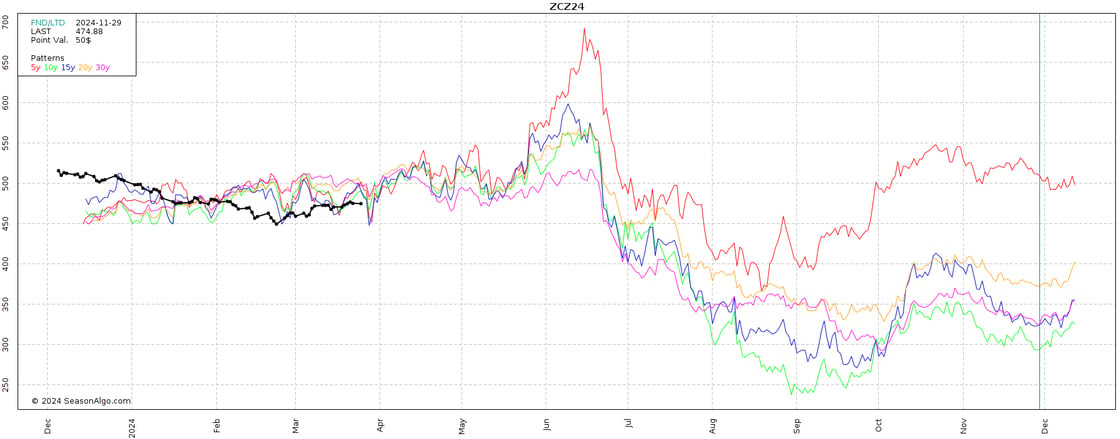
Below is a look at price averages for December corn, using the 5, 10, 15, 20, and 30 year averages. Though we believe we can see prices firm from these levels, we would urge Producers to temper the expectations, given the current balance sheet.
Soybeans
Technicals (May)
May soybeans had an impressive rally yesterday, erasing most of Friday’s losses. The choppy trade feels like it’s shaking the trees to get the week hands out of position ahead of Thursday’s report. $12.00 will the technically and psychologically significant pocket that Bulls will want to keep a close eye on into and after the report. A weekly close above or below here could set the tone as we turn the calendar over into April.
Bias: Neutral/Bullish
Resistance: 1212 3/4-1216, 1240 1/2, 1250-1252***
Pivot: 1198-1205 1/2
Support: 1175-1181, 1161-1167**

Fundamental Notes
- The average estimate for soybean acres comes in near 86.5 million. The range of estimates come in from 85.35-88.0.
- Yesterday’s weekly export sales was reported at 768,711 metric tons, within the range of expectations and about 68k MT more than last week.
- Markets will be closed on Friday in observance of Good Friday.
Fund Positioning
Friday’s Commitment of Traders report showed Funds were net buyers of roughly 7k contracts, nearly all of which was short covering. That trims their net short position down to 148,339 futures/options contracts. Broken down that is 56,166 longs VS 204,505 shots.

Seasonal Trends
(Past performance is not necessarily indicative of future results)
- Below is a look at price averages for November soybeans, using the 5, 10, 15, 20, and 30 year averages.

Wheat
Technicals (May)
May wheat futures broke out above trendline resistance yesterday morning but struggled to hang on to the bulk of those gains through the session. The market has pulled back some to test the breakout point, 550-555. The Bulls need to defend this pocket through today’s trade to keep the ball in their court and the hopes of a retest of the 50-day moving average alive.
Bias: Neutral/Bullish
Resistance: 563-570, 595 3/4-600, 608 1/2-611**
Pivot: 550-555
Support: 525**

Fundamental Notes
- The average analyst estimates for wheat acres come in near 47.3 million.
- Weekly export sales were reported at 315,395 metric tons, within the range of expectations and about 80k MT less than last week.
- Markets will be closed on Friday in observance of Good Friday.
Fund Positioning
- Friday’s Commitment of Traders report showed little change in the Funds net positioning, holding a net short of 80,570 futures/options contracts. Broken down that is 80,721 longs VS 161,291 shorts.

Seasonal Trends
(Past performance is not necessarily indicative of future results)Below is a look at price averages for July wheat, using the 5, 10, 15, 20, and 30 year averages. Historically this isn’t the most friendly time of year.
